The Blazer Effect: How Structure Speaks Before You Do
Few garments have travelled across time, gender, and geography with the authority of the blazer. Season after season, decade after decade, it remains unmoved by the rise and fall of trends. Neither strictly formal nor casually dismissible, the blazer occupies a rare space in fashion—where structure meets expression, and presence is shaped before a word is spoken.
More than a garment, the blazer is an attitude. One that signals intent.
Where It Began: From Uniform to Identity
The blazer’s origins lie in utility. Born in the nineteenth century as part of naval and sporting uniforms, it was designed for discipline, hierarchy, and clarity. Early blazers were rigid, sharply tailored, and unmistakably authoritative—crafted to command attention rather than invite interpretation.
Over time, this functional uniform crossed into civilian wardrobes, gradually shedding exclusivity while retaining its defining feature: structure. By the mid-twentieth century, the blazer had become a symbol of professionalism and credibility, worn in courtrooms, boardrooms, and academic institutions alike.
What remained unchanged was its purpose—to frame the body with intention and establish presence instantly.
The Architecture of a Blazer
A blazer does not begin at the lapel or the hem. It begins at the shoulders.
Shoulder construction determines everything that follows—the line of the torso, the fall of the fabric, and the authority of the silhouette. Lightly padded shoulders create fluidity, allowing the blazer to move as an extension of the body, making them ideal for contemporary, everyday tailoring. In contrast, hard-padded shoulders introduce angularity, drawing from classic power dressing and lending an unmistakable sense of dominance and control.
Beyond the shoulders lies the discipline of craftsmanship. Panel placement, darting, seam construction, and balance dictate how a blazer sits, how it moves, and how it holds its form over time. This invisible architecture is what transforms fabric into form, ensuring that a blazer communicates refinement rather than rigidity.
True tailoring is felt before it is noticed.
The Fit Spectrum: Expression Through Proportion
As the blazer evolved, fit became its most expressive element—allowing wearers to define how structure interacts with individuality.
Boxy fits embrace relaxed tailoring while preserving architectural clarity. Defined by straight cuts and broader silhouettes, they offer comfort without surrendering authority. Their versatility allows them to transition effortlessly between professional and social settings, making them ideal for long wear and layered styling.
Cropped blazers bring a contemporary edge to a classic form. By shortening the length, they draw attention to proportion, highlighting the waist and torso. The result is a sharp, modern silhouette that feels intentional and fashion-forward, transforming the blazer into a statement rather than a backdrop.
Each fit speaks differently, yet all rely on balance—where proportion becomes personality.
Styling the Blazer: A Modern Language
The blazer’s enduring relevance lies in its adaptability. Across cultures and generations, it has been styled to reflect shifting ideas of power, ease, and expression.

Clean and Sophisticated Styling
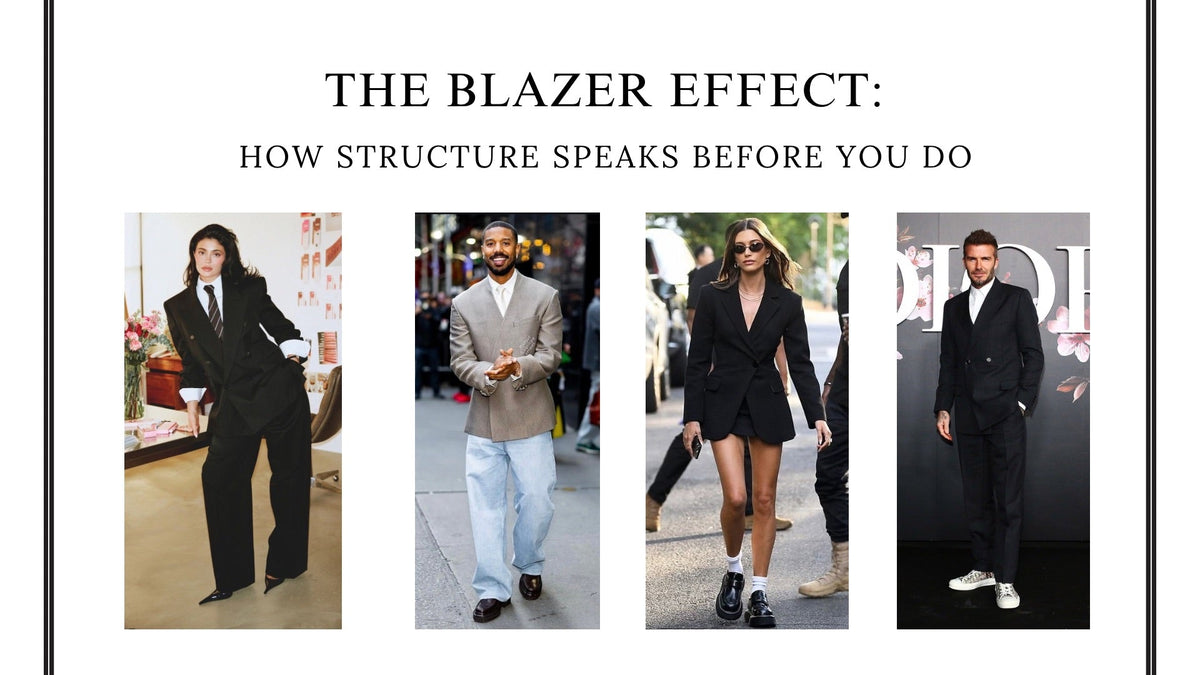
Understated tailoring paired with crisp shirts and refined fabrics demonstrates how simplicity can convey quiet confidence. Sharp cuts and minimal layering allow the blazer to lead, proving that restraint can be as impactful as excess.

Casual Interpretation
Relaxed or oversized blazers worn with denim and minimal layers soften structure without diluting presence. This approach introduces ease, making the blazer part of everyday dressing rather than an occasion-bound piece.

Contemporary Expression
Cropped cuts, experimental proportions, and bold textiles blur the line between classic tailoring and expressive dressing. Here, the blazer becomes a canvas—structured, yet open to interpretation.

Statement Dressing
When worn as a standalone piece, the blazer transforms into a declaration. Its structure replaces the need for ornamentation, allowing confidence and silhouette to take centre stage.
In every form, the blazer adapts without losing its core identity.
The Orthodox Perspective: Structure With Intention
At Orthodox, the blazer is not treated as a trend-driven essential but as a study in proportion, movement, and restraint. Every decision—from shoulder construction to fit—is guided by intention rather than excess.
We believe that true power dressing does not demand attention; it earns it. A well-crafted blazer does not overpower the wearer—it sharpens their presence, allowing confidence to emerge naturally.
In an age of fleeting fashion, the blazer endures because structure never goes out of style.
It evolves.
It adapts.
And it continues to speak—long after trends fall silent.