Indian Art on the World Stage: Chikankari, Hand Stacked Bangles and the Wrap That Travels
Fashion’s current moment isn’t about discovering something new.
It’s about rediscovering what has always existed , and recognising where it came from.
From the runways of Paris to the racks of H&M, Indian craftsmanship is no longer background embroidery. It’s becoming the story itself.


The New Global Relevance of Indian Craft
In 2025, the global lens on Indian artistry widened further.
Designers like Hussain Rehar and Anamika Khanna are rewriting how Indian subcultures are interpreted in luxury and ready-to-wear alike.
Anamika Khanna’s collaboration with H&M earlier this year captured this beautifully , merging intricate Indian handwork with accessible silhouettes for a younger, international audience. It showed that Indian art could travel far beyond occasionwear. A mirror to India’s new design identity: rooted, but restless.
Across the border, Hussain Rehar’s couture presentations took craftsmanship to a global platform, bringing the subcontinent’s design language into conversations of modern luxury. Both designers have proven that Indian craft doesn’t have to whisper heritage; it can speak the language of global relevance.

Dior and the $200,000 Coat
Then came a moment that set the industry abuzz.
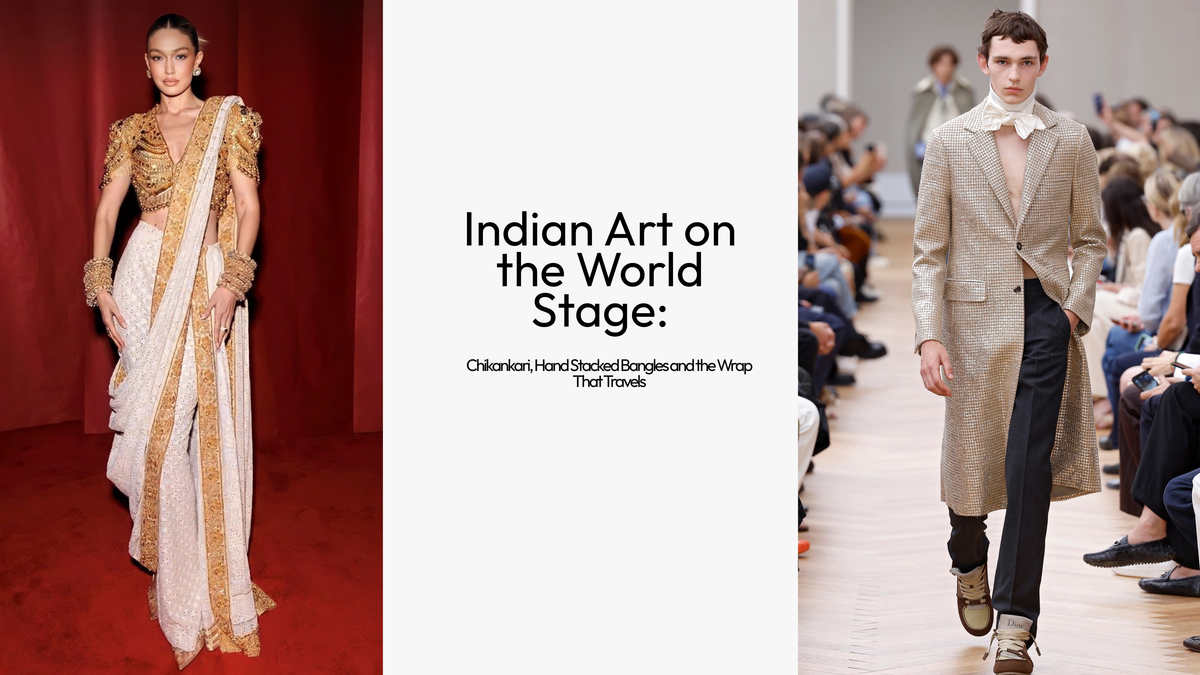
At Dior’s Fall 2025 couture collection, newly appointed creative director Jonathan Anderson unveiled a breathtaking metallic coat , a showstopper priced at nearly USD 200,000. Its shimmer came not from sequins or synthetics, but from Mukaish, the ancient Indian craft of weaving silver thread into fabric.
The technique originates in Lucknow, where artisans have practiced it for centuries, often by hand and often unseen.
The piece was exquisite , and yet, it sparked a conversation far beyond the runway. Many pointed out that while the garment received global acclaim, the Indian ateliers and artisans behind the embroidery remained unnamed.
The debate was not about critique, but credit.
Luxury is finally realising that craft is not just an embellishment; it is intellectual property. And provenance is its proof.

What This Means Strategically
From a brand and design standpoint, Dior’s choice was significant. It demonstrated how a deeply Indian craft can be reframed within a Western luxury silhouette. A traditional embroidery technique, once reserved for bridalwear or heirloom pieces, became the centerpiece of a global couture garment.
For Indian designers, it’s a powerful case study. Craft can evolve beyond its expected form.
A Chikankari motif can belong just as naturally on a tailored blazer as on a saree. Mukaish can appear on a trench coat lapel. Zardozi can detail a minimalist evening dress. The artistry doesn’t lose its essence; it simply gains new context.
From Dupattas to Scarves: The Circle of Style
Meanwhile, in the wider fashion landscape, trends that echo Indian culture continue to reappear under new names.
The “Scandinavian scarf” , a draped wrap slung over shoulders in soft, neutral hues , mirrors the elegance of the Indian dupatta.
The “Ibiza top” , bejewelled, embroidered, and carefree , feels unmistakably familiar to anyone who’s seen mirror work from Kutch or sequin embroidery from Gujarat.
Even the stacked gold wrist, now the hallmark of quiet luxury campaigns, has lived in Indian homes for generations as our mothers’ kadas.


This isn’t a story of imitation. It’s one of resonance.
Indian aesthetics have always influenced global fashion , today, that influence is finally visible.
Indian Subcultures as the New Language of Luxury
Indian design isn’t becoming global; it always was.
What’s changing is the lens through which it’s viewed.
The world is no longer looking at India for “inspiration.” It’s looking for collaboration.
From Dior’s ateliers to Anamika Khanna’s high-street moment, craft is being reframed as a contemporary design language , not a mere heritage nostalgia.
This marks an important evolution for Indian subcultures:
They are no longer peripheral. They are primary.
The drape, the embroidery, the stack, the shimmer , these are the new codes of global sophistication.

For Orthodox Design: The Path Forward
For your Chikankari-based collection at Orthodox Design, the takeaway is clear.
Craft does not need to be confined to traditional silhouettes like sarees or kurtas.
It can live , and thrive , within structured blazers, coats, trousers, and hybrid outerwear.
When you design a chikankari-lined jacket or a blouse with visible mukaish detailing on the cuff or lapel, you’re not just modernising craft. You’re placing it in dialogue with the world.
But most importantly, ensure the story of the artisan travels with the garment.
Provenance is power. Dior’s misstep with crediting its Indian embroidery serves as a reminder that authenticity and storytelling must go hand in hand.
For Orthodox, this is your strategic edge:
Highlight the hands behind the thread.
Let the craft speak , and let the world listen.
The Larger Truth
The world is finally dressing in what India has always made.
From Lucknow to Paris, Jaipur to Milan, our artistry is weaving its way into global wardrobes.
Perhaps the most elegant aspect of this Renaissance is its quietness.